Showing posts with label roosters. Show all posts

Thursday, July 10, 2008

You Gotta Keep 'Em Separated

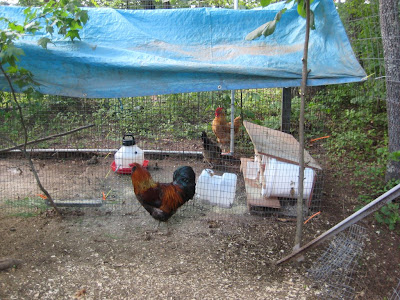
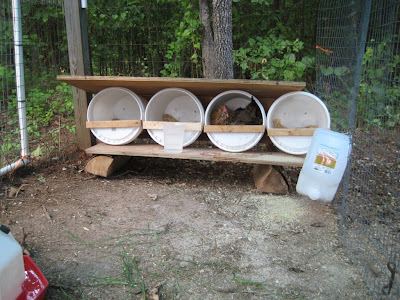
To prepare for the hatching of the eggs, we ("we" meaning Dionne) set up a separate enclosure within the existing chicken run---a cage within a cage, if you will. Apparently, other hens might be rough with the newborn chicks and the roosters may flat out kill them. The top level of our bucket nest structure was only held in place by its own weight which made it easy to relocate to the new enclosure, broody hen and all. Below you see the two roosters curious and desperate to get into the restricted area.

For now, our sick (but nearly recovered) hen Chewhair will share this space. In fact, when broody Beach Bunny got up to stretch her legs, Chewhair took over the incubating for a few minutes.

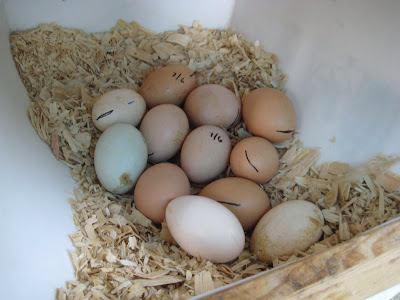
We also got a quick peek at the eggs to see if any were cracked or rotten.


You can see here that we marked them initially to make sure that no new eggs were added to the clutch which would make it hard to track hatchling schedules. We found out that using a regular pencil is better than a Sharpie because the eggs are indeed porous...you live and you learn.

Thursday, July 03, 2008

A Sick Chick

This morning when we let out the chickens, Chewhair (an Araucana) stayed silently on her roost*, looking rather sleepy and weak. Dionne had to actually place her on the ground, and then help her back up into a nesting box when she continued her lethargic behavior. Dionne's mom provided us with some worming medicine (which means we have to take her out of production and discard her eggs), but this is worth the small price to pay to possibly save her life. We really don't know what's wrong with her at this point, so we've put Chewhair into quarantine just in case. The rest of the flock is being treated with Diatomaceous Earth and Apple Cider Vinegar as a precaution. We were planning on building a separate area for the broody hens this 4th of July weekend anyway, guess now we have a head start!

*I just thought of something while writing this post. Does the word "rooster" mean something that roosts?

Tuesday, May 27, 2008

Spur of the Moment


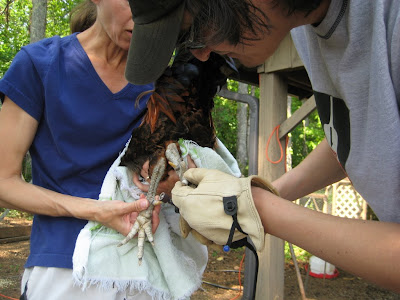
We've noticed that many of our hens are getting scratched during mating, so we decided sand down lead rooster Fluffy's spurs a little bit. Although you would think that chickens could use their beaks for self-defense, they really just rely on their spurs to fight off predators. Once we caught Fluffy, we put a towel over his head to reduce the stress and I went to work with a sanding bit on my Dremel tool while Dionne held him steady. I was surprised that there was some bleeding almost immediately after I began sanding (I thought the spurs were solid bone or keratin), but it stopped quickly. We ended up just rounding the spurs a little bit in the end.

Monday, February 25, 2008

Attack of the Hawk

A few weekends ago, we witnessed a hawk take down a dove on our back patio at the rental cottage. A lot of feathers and squawking, but also a reminder of the predator/prey circle of life. Just two days ago, we experienced our first hawk air raid on the chickens. It was the early afternoon when we heard a commotion outside and we caught a glimpse of the chickens scurrying into the safety of their coop. Maya exclaimed "Hawk in the chicken coop!" and the sound of nearby panicking crows confirmed the danger. I ran outside still in my socks, clapping my hands to make as much noise as possible. By the time I got to the chicken run the chickens were all in their coop and clucking in alarm mode---no sign of the hawk, but two kinds of feathers scattered around. I counted the chickens (no easy feat when they are weaving around each other), then counted them two or three more times. 27 sounded like the right number but I asked Maya if she noticed any missing hens (she can identify them better than any of us). The feathers belonged to a random buff orpington survivor and to our lead Araucana rooster, Fluffy. Maya was shaken by the near-death experience but I reassured her that Fluffy was a hero, having protected his hens from the predator at the cost of a few feathers (which were then taped to a sheet of paper in honor of his courage). For several hours, the chickens stayed in their coop unless a human was nearby, and then we decided to add a barrier to the exposed top of the chicken run by stringing some twine back and forth like a loose web roof.


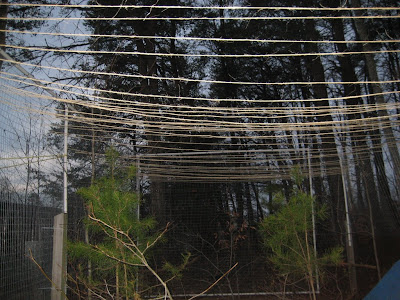
This won't stop a hawk, but it will hopefully serve as a deterrent to buy the chickens a few seconds to escape to safety should there be another attack. Despite our efforts to protect the chickens, we must accept natural attrition and predation if we intend to go fully free-range with these egg-layers in the future. One solution, I'm told, is to get goats mixed into the flock.

Some Kind of Houdini

Over the past week, one of our Araucanas (which 8-year-old Maya tells us is "Gloria") had figured out how to escape the 10-foot-tall fencing surrounding our chicken run. Fortunately, she doesn't go far, but it has been a problem since we're not quite ready to go completely free-range. Yesterday, we were able to observe Gloria in action making a completely vertical flight to the top of the fencing where Maya promptly pushed her back into the chicken run with the handle-end of a nearby shovel. My theory is that this hen is smaller and therefore lighter than the rest of the chickens. Maya's theory is that she is simply smarter. As it turns out, Gloria does seem to have some sort of motivation.


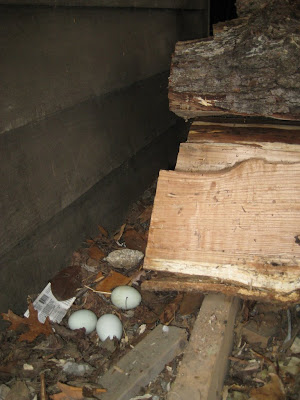
While bringing in some firewood, we noticed a small nest of three Araucana eggs behind the woodpile and Dionne had mentioned seeing her back there during one of her escapades. It appears that Gloria was trying to find a way to keep her eggs from their breakfast plate fate, and it also explains our recent fluctuating egg count. A for Effort, Gloria.

Friday, February 08, 2008

The Chickens Have Landed

We finally had time last weekend to complete the new Sugar Mountain Farm-inspired chicken coop and the egg-layers have been relocated to Rose Cottage. The whole set-up at the rental cottage is designed to be modular and temporary, yet sturdy enough to secure the chickens and withstand the weather (cold, wind, and rain). Click here to view the entire construction process from start to finish. The chickens went right to clearing out the vegetation in their new run, and hardly skipped a beat when it came to laying eggs (sometimes traumatic happenings such as a physical move can cause them to stop laying). We were able to move them over in a makeshift cage in the back of Danna's pickup truck, although it took two trips. The old chicken run on the Smith property will be recycled into a dog run for their two new farm dogs, Abbie and Axel. The real beauty of relocating the chickens is the sheer convenience of having our twice-daily chores right outside the door versus a mile away. The kids appreciate being able to sleep in a little, too.

Friday, December 28, 2007

Culling Out the Roosters

Warning! This blog post is not for the faint of heart as it contains gore and some adult content! Part of learning to be self-sustaining is getting back to the basics of raising animals for food and "processing" them yourself. Eggs are good, but A) we're an omnivorous family and B) we ended up with too many roosters (that's male chickens for you city folk). You see, the roosters aren't all that productive...it's the hens that are doing all the egg-laying while the males just strut around, lend an air of security to the flock, and rudely pluck feathers from the back of the females who are haplessly gang-banged chicken-style. They also get aggressive toward each other, and sometimes toward their keepers. Well, we'll have none of that on Blue Harvest Farm! Before culling out the roosters (not all of them), we did some online research on this site and this one. We tried two different methods of processing, the first of which was to tie the rooster upside-down by his feet to a horizontal bar, cut his head off with a knife, then skin him feathers and all by making strategic incisions and literally peeling everything off from feet to neck. This method avoids feather-plucking and the boiling method described later. As we thought this might be interesting to document, we took photos and some video as well. Well, let's just say that you need to make sure your knife is sharp. Dionne, bless her heart, volunteered to do the dirty deed but cutting through the neck bones proved more difficult than we anticipated. Dionne's mom (a slightly more experienced chicken-killer) had to finish the job for us while I recorded the incident on video. The evidence was subsequently erased when it was decided that our educational video was really more like a snuff film. Egads, it was an emotional trauma. The next attempt (for which I was not a witness) was more successful (and merciful) with the aid of a chopping block and sharp machete. This time, the headless chickens were boiled in a large pot for a few seconds which opens their pores enough to make plucking feathers a breeze. The skin remains on the chicken, but that doesn't bother us. After all the killing was done, three roosters remained: one for a partner of Daisy (Dionne's mom's pet hen), one to keep structure in the flock (his name is Fluffy Chick), and one who escaped detection by impersonating a hen (still not sure about its gender really).