Showing posts with label chickens. Show all posts

Tuesday, December 29, 2009

Snow Came Early


We usually don't get any snow until after the new year, but we got a good 4-6 inches on December 18th and Collinsville Road right in front of our house was particularly treacherous. The ice pellets and freezing rain did make for some good sledding though! We'll see if there's any more in store for us this winter.


The chickens (including some new pullets) didn't care for cold feet and stuck mainly to a few paths that we shoveled clear for them so they could travel from coop to shelter and back. Needless to say, the days following the snowfall were a muddy mess. The good news is that egg production is picking up again after a long moult, and we are now getting around a dozen a day.

Saturday, January 10, 2009

The Missing Dozen

Yesterday, All Bright Sanitation (828.894.5009) came to swap out the big yellow construction dumpsters. Despite the treacherous nature of giant machines lifting and pushing a 22-foot-long steel container filled with a ton of debris, 12 delicate eggs were found unscathed in a small nest beneath the dumpster. A little backstory: Checkers, the only hen of our three hatchlings from last July, seems to be following in the footsteps of Gloria, our Araucana "Houdini". Checkers has been consistently jumping the 4-foot-tall chicken wire fencing of the new chicken run. We found it futile to put her back in, so we let her explore the new grounds on her own despite the dangers of being a lone wandering hen. Since she is the youngest Araucana, we can distinguish her eggs because they are smaller than normal and blue-green. We found one of her eggs near the edge of the forementioned dumpster a while back, but didn't realize she had continued to lay them further under, where we couldn't see them. This morning, Checkers let herself out, as usual, and was wandering around the exact spot where the dumpster (and her dozen eggs) were located just 24 hours earlier. Poor girl didn't know what to do so she ended up just laying today's egg in the grass. While the eggs may still be good, they may have been damaged due to recent freezing temperatures so we're giving them to the dogs---not our customers. :-)

Sunday, December 14, 2008

Garage Move-In

This past weekend, we acclimated ourselves to the new sounds and new smells of a new structure as we moved into the garage apartment. Bathroom and foyer tile have been laid and floated but still need to be sealed. Some spots on the wall are uneven and need to be repainted. The kitchen cabinets and microwave need to be lowered a few inches. The stairs need to be sanded and stained. While there's still much to be done, the loft-style garage apartment is now complete enough for the whole family (including the dogs) to actually live at the site. Sunday was spent relocating our egg-laying friends. We picked up 150 feet of chicken wire to create a large open run behind the garage.

Fortunately, our original coop design was portable enough to bring to the new property (with the help of our landlord's Ford pickup truck). At dusk, we boxed up the first batch of chickens and brought them to their new home. Despite the low four-foot-tall fence, we'll try to hold off on free-ranging until they are familiar with the new location and/or we get our new super-portable hotwire fencing solution set up (more on that later). The upshot of the move is that we can now bring our Rose Cottage lease to an end and start applying that monthly payment toward something else, like the new car.

Saturday, October 11, 2008

Replenishing the Flock


Paid a visit to Foothills Alpacas and picked up 11 Plymouth Barred Rock pullets and one Rhode Island Red this weekend to replace some of the hens we've lost over the past year.

These new birds will be kept separated from the rest of the chickens until they mature a bit more. They are too young to compete with the larger chickens for food and we worry about free-ranging them at the rental cottage for such a short time---might as well get them on the new Collinsville Road property.

Using mostly existing materials from previous coop construction, we made another smaller hoop house and fenced off the back section of the run (which isn't used by our free-ranging older birds.


Apart from the one Barred Rock with a deformed foot and the singular Red, we can't tell any of them apart... but the kids can!

The kids have begun the usual process of naming them which means we won't be eating them.

Wednesday, July 30, 2008

Super Genius


(Sample photo)

Just a quick post that we had a coyote visit this past weekend. We heard the chickens squawking loudly outside and I peered out the window toward the coop and saw what looked like a medium-sized dog about 15-20 feet into the woods behind Rose Cottage. We've had stray/lost/feral dogs come around a few times before, but then I saw the bigger ears and thinner face of a coyote. Before I could get outside, it did a double-take at the chickens and rather calmly walked back into the trees. It was either confused by the loud chicken alarm calls or simply on a reconnaissance mission. While we worry about the flock, we also realize that free-ranging has its price and there will be predation.

Thursday, July 10, 2008

You Gotta Keep 'Em Separated

To prepare for the hatching of the eggs, we ("we" meaning Dionne) set up a separate enclosure within the existing chicken run---a cage within a cage, if you will. Apparently, other hens might be rough with the newborn chicks and the roosters may flat out kill them. The top level of our bucket nest structure was only held in place by its own weight which made it easy to relocate to the new enclosure, broody hen and all. Below you see the two roosters curious and desperate to get into the restricted area.

For now, our sick (but nearly recovered) hen Chewhair will share this space. In fact, when broody Beach Bunny got up to stretch her legs, Chewhair took over the incubating for a few minutes.

We also got a quick peek at the eggs to see if any were cracked or rotten.


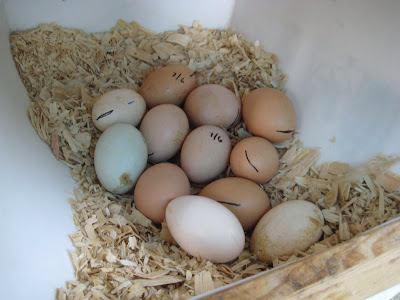
You can see here that we marked them initially to make sure that no new eggs were added to the clutch which would make it hard to track hatchling schedules. We found out that using a regular pencil is better than a Sharpie because the eggs are indeed porous...you live and you learn.

Thursday, July 03, 2008

A Sick Chick

This morning when we let out the chickens, Chewhair (an Araucana) stayed silently on her roost*, looking rather sleepy and weak. Dionne had to actually place her on the ground, and then help her back up into a nesting box when she continued her lethargic behavior. Dionne's mom provided us with some worming medicine (which means we have to take her out of production and discard her eggs), but this is worth the small price to pay to possibly save her life. We really don't know what's wrong with her at this point, so we've put Chewhair into quarantine just in case. The rest of the flock is being treated with Diatomaceous Earth and Apple Cider Vinegar as a precaution. We were planning on building a separate area for the broody hens this 4th of July weekend anyway, guess now we have a head start!

*I just thought of something while writing this post. Does the word "rooster" mean something that roosts?

Sunday, June 29, 2008

Broody Time


Since we have lost (sometimes quite literally) a few hens over the past year, we decided to let some hens go broody in hopes of baby chicks this summer. We left some eggs in the coop for a few days and several hens took turns sitting during the day, until Beach Bunny, a buff orpington, was the first to commit to an overnight stay (they normally all go up on their wooden branches in the coop to roost). Beach Bunny is currently sitting on about six eggs of various breeds, and we have marked them in case other hens decide to squeeze in and lay new ones. If the 21-day cycle is accurate, and the eggs were fertilized by one of our roosters, then we should have some new additions to the family around Friday, July 18th. While Beach Bunny squawks in defense of her nest, and has puffed herself up practically filling an entire 5 gallon nesting box, we still need to move her away from the rest of the flock so that the other hens won't go broody (which means egg production slows or even stops!) and so that the newly hatched chicks won't be subject to harm from other chickens. She seems to get off the nest periodically for food and water, but we've been bringing her water and fresh greens which she seems to appreciate.

Monday, April 28, 2008

Not Your Typical Bucket o' Chicken


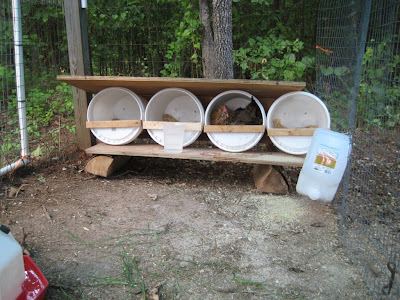
In an effort to make more use of the limited space inside our wire-hoop chicken coop, we've replaced the deteriorating waxed cardboard boxes (which can't be recycled) with eight 5-gallon plastic buckets. We modified the buckets by removing the handles and cutting the lids a little less than half-way across to keep bedding material from falling out, yet still allowing enough space for the hen ingress and egress. We then nailed a small strip of wood to the cut edge of each lid to eliminate the sharp edge and provide a comfortable step. The base of each bucket was then screwed to a wide plank of plywood in two rows of four which stack neatly and are surprisingly stable considering they aren't tied down. We then filled each bucket with pine shavings to complete this modular-style nesting box that can be easily moved and/or cleaned. We'll let you know if the chickens like it. Click here for more photos of the bucket chicken condo.

Monday, April 14, 2008

Let Them Eat Snake


If you love something, set it free---as in free range. You've probably seen and heard the term "free range" but what does it really mean? The U.S.D.A. (United States Department of Agriculture) allows labels to say free range if they have "certified access to the outdoors," but does not specify other criteria such as the quality of the land/environment, size of roaming area, or the number of birds confined to a particular space. In other words, some chickens could be defined as free range simply by having a small run with nothing but gravel or mud. Also beware that there are no standards governing the term "range" or similar advertisements on egg cartons, such as "free running," "free roaming," or "free walking." True free range allows for chickens to sustain themselves on their natural surroundings.

About a week ago, with the okay of our landlord (who seems to have turned over a new leaf lately), we decided to bite the bullet and let the chickens roam free in the yard. We trust that they will use their instincts to determine what is food and what isn't, but just in case we scoured the property to ensure there were no obvious threats (physical or chemical). Like letting your child go off by themselves for the first time, we were nervous parents, imagining hawk attacks, lost hens, and other untold dangers. However, the flock doesn't wander far and we have yet to lose any to the nearby woods or the neighbor's car...they return to their coop each night as the sun sets and the headcount is always the same.

Now, aside from the usual plants and insects you'd expect them to eat in the wild, our flock is expanding their palate to include such things as small snakes (we caught them playing tug o' war with the one pictured above). Whether or not they actually ate it is anyone's guess since they are competitive about rare treats and will run off to finish their meal in seclusion. We've also noticed that they no longer seem to think that being handfed is such a novelty.

Sunday, April 13, 2008

R.I.P. Dalmation Temptation


Sad news. Our one and only Silver Laced Wyandotte died. Dionne went out to collect eggs around 2pm on April 4th and she was laying there in the coop. She was fine in the morning, but had been dead for a little while because rigormortis had begun to set in. Dionne checked the inside of her mouth and it wasn't black, so we don't think it was worms or coccidiosis or anything harmful to the rest of the flock (who have been absolutely fine). Her lower abdomen was swollen and her oviduct was slightly expanded, so we think Dalmation was eggbound...this can cause a quick death if not caught early. Maya was pretty upset, of course, and Dalmation (whose was named for her black and white Dalmation-style spots and a word that rhymed with "dalmation") was buried in the backyard of the cottage complete with stones and flowers to mark the grave. We initially referred to this hen as "mystery chick" since she was of a different breed than the rest. Dalmation is pictured above with wildflowers sprinkled on her back's "bald spot" courtesy of the kids.

Monday, February 25, 2008

Attack of the Hawk

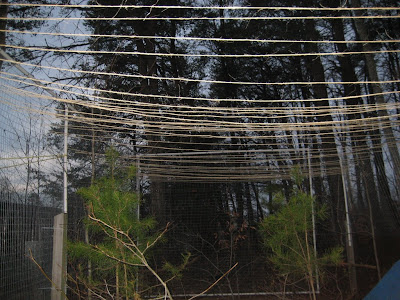
A few weekends ago, we witnessed a hawk take down a dove on our back patio at the rental cottage. A lot of feathers and squawking, but also a reminder of the predator/prey circle of life. Just two days ago, we experienced our first hawk air raid on the chickens. It was the early afternoon when we heard a commotion outside and we caught a glimpse of the chickens scurrying into the safety of their coop. Maya exclaimed "Hawk in the chicken coop!" and the sound of nearby panicking crows confirmed the danger. I ran outside still in my socks, clapping my hands to make as much noise as possible. By the time I got to the chicken run the chickens were all in their coop and clucking in alarm mode---no sign of the hawk, but two kinds of feathers scattered around. I counted the chickens (no easy feat when they are weaving around each other), then counted them two or three more times. 27 sounded like the right number but I asked Maya if she noticed any missing hens (she can identify them better than any of us). The feathers belonged to a random buff orpington survivor and to our lead Araucana rooster, Fluffy. Maya was shaken by the near-death experience but I reassured her that Fluffy was a hero, having protected his hens from the predator at the cost of a few feathers (which were then taped to a sheet of paper in honor of his courage). For several hours, the chickens stayed in their coop unless a human was nearby, and then we decided to add a barrier to the exposed top of the chicken run by stringing some twine back and forth like a loose web roof.


This won't stop a hawk, but it will hopefully serve as a deterrent to buy the chickens a few seconds to escape to safety should there be another attack. Despite our efforts to protect the chickens, we must accept natural attrition and predation if we intend to go fully free-range with these egg-layers in the future. One solution, I'm told, is to get goats mixed into the flock.

Some Kind of Houdini

Over the past week, one of our Araucanas (which 8-year-old Maya tells us is "Gloria") had figured out how to escape the 10-foot-tall fencing surrounding our chicken run. Fortunately, she doesn't go far, but it has been a problem since we're not quite ready to go completely free-range. Yesterday, we were able to observe Gloria in action making a completely vertical flight to the top of the fencing where Maya promptly pushed her back into the chicken run with the handle-end of a nearby shovel. My theory is that this hen is smaller and therefore lighter than the rest of the chickens. Maya's theory is that she is simply smarter. As it turns out, Gloria does seem to have some sort of motivation.


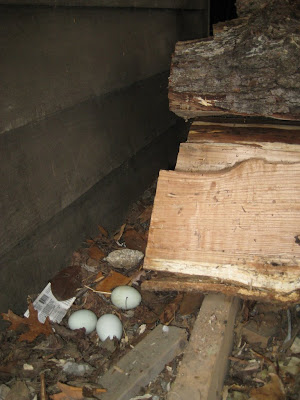
While bringing in some firewood, we noticed a small nest of three Araucana eggs behind the woodpile and Dionne had mentioned seeing her back there during one of her escapades. It appears that Gloria was trying to find a way to keep her eggs from their breakfast plate fate, and it also explains our recent fluctuating egg count. A for Effort, Gloria.

Friday, February 08, 2008

The Chickens Have Landed

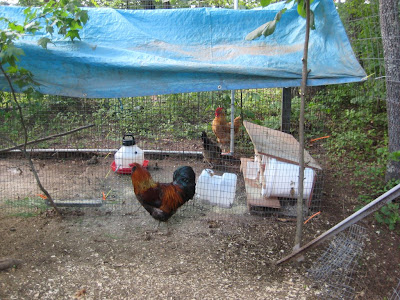
We finally had time last weekend to complete the new Sugar Mountain Farm-inspired chicken coop and the egg-layers have been relocated to Rose Cottage. The whole set-up at the rental cottage is designed to be modular and temporary, yet sturdy enough to secure the chickens and withstand the weather (cold, wind, and rain). Click here to view the entire construction process from start to finish. The chickens went right to clearing out the vegetation in their new run, and hardly skipped a beat when it came to laying eggs (sometimes traumatic happenings such as a physical move can cause them to stop laying). We were able to move them over in a makeshift cage in the back of Danna's pickup truck, although it took two trips. The old chicken run on the Smith property will be recycled into a dog run for their two new farm dogs, Abbie and Axel. The real beauty of relocating the chickens is the sheer convenience of having our twice-daily chores right outside the door versus a mile away. The kids appreciate being able to sleep in a little, too.